

Clear, current rules for Non-Resident Indians investing in Indian insurance, mutual funds, and gold — and how we help you navigate them.

Governed by IRDAI regulations and FEMA, 1999.


NRIs, OCIs, and PIOs are fully eligible to buy and hold Indian life insurance policies. Most insurers accept applicants aged 18–60, though this varies by insurer. A PAN card is mandatory in every case. Each insurer also maintains its own list of permitted countries of residence — this list is revised periodically and differs across insurers, so it's worth checking before applying. US residents in particular face tighter restrictions at several insurers, separate from the FATCA/tax issue — this stems from US state-level insurance licensing rules, not Indian regulation.

Premiums can be paid from an NRE, NRO, or FCNR account, or via direct inward remittance from abroad. Eligible NRI/OCI policyholders can also claim a GST exemption on renewal premiums, subject to conditions set by the insurer.

Three routes are commonly used: an in-person medical during a visit to India, tele-medical underwriting (a phone-based health questionnaire for lower sum-assured cases), or a video medical conducted by a partner clinic in your country of residence.

A policy bought while resident in India stays fully in force after you move — it isn't cancelled. What changes is administrative: update your KYC and residency status with the insurer, and switch the premium-payment and payout accounts to NRE/NRO/FCNR as applicable.

Claims are honoured wherever the nominee resides. Premiums may qualify for deduction under Section 80C, and maturity/death benefits under Section 10(10D) of the Income Tax Act, subject to prevailing law — NRIs should confirm current applicability with a tax advisor, and check DTAA provisions for their country of residence. Whether the payout is freely repatriable follows the same logic as mutual funds: proceeds credited against an NRE-funded policy are typically fully repatriable, while NRO-linked proceeds fall under the standard USD 1 million per financial year ceiling.

Health cover bought in India is primarily designed for treatment taken within India — useful for parents/family back home, or for your own visits. Cashless network access and claim procedures vary by insurer, so confirm exactly what's covered while you're actually abroad versus during an India visit.
Most NRI clients still own a vehicle or a home/flat in India that needs covering.

If you still own a car or two-wheeler registered in India — often used by family while you're abroad — it needs valid insurance regardless of your residency status. NRIs can buy or renew motor policies the same way residents do; premium can be paid from an NRE/NRO account, and a family member or POA holder can usually handle any physical formalities (like a survey after an accident) on your behalf.

A home or flat left vacant or rented out while you're abroad is exactly the kind of asset structure fire and burglary cover, and home insurance, is designed for. NRIs can insure property they own in India; premium payment and claim payouts follow the same NRE/NRO/repatriation rules as other categories on this page.
Governed by SEBI and FEMA regulations.

NRIs, OCIs, and PIOs can invest in Indian mutual funds — SIP or lump sum, equity, debt, or hybrid schemes. All investments must be made in Indian Rupees through an NRE or NRO account; you cannot wire foreign currency directly to a fund house.
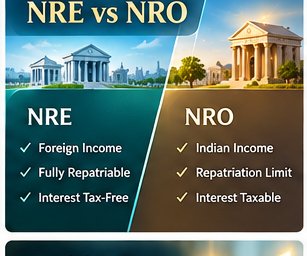
NRE: funded from foreign income, fully repatriable, interest tax-free in India. NRO: funded from Indian-sourced income (rent, dividends), repatriation capped at USD 1 million per financial year, interest is taxable. Which one you use changes how freely you can move money back out.

A one-time KYC is mandatory, often requiring In-Person or Video Verification for NRIs. If you're a US tax resident, FATCA reporting requirements also apply — you'll need to declare your country of tax residence and foreign tax ID. Note that the easy Aadhaar-based paperless eKYC route generally needs an Indian mobile number linked to your Aadhaar — without one, you'll go through offline or video KYC instead, which takes a little longer.

Due to FATCA/CRS compliance costs, a number of Indian AMCs don't accept fresh investments from US- or Canada-based NRIs. Several AMCs do still accept them — which ones vary and change over time, so we check current acceptance before recommending a scheme.
TDS is deducted at source when you redeem, based on the fund type and holding period. This shows up in your Form 26AS and can typically be used as a credit when filing taxes in your country of residence, subject to the applicable DTAA.
Governed by RBI regulations under FEMA.

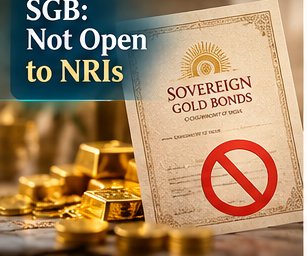
SGBs have always been restricted to resident Indians, HUFs, trusts, and charitable institutions — NRIs cannot make fresh SGB investments under RBI/FEMA rules. Separately, fresh SGB issuance was discontinued for everyone (including residents) after February 2024. If you bought SGBs while resident and later became an NRI, you can continue holding them to maturity, but proceeds are non-repatriable and credited to your NRO account.

NRIs can typically invest in Gold ETFs through a demat and trading account linked to their NRE/NRO holdings, under the applicable investment route. Liquidity is good since they trade on the exchange like shares.
Gold Fund-of-Funds follow the same NRI mutual fund rules covered above — NRE/NRO account, KYC, and (for US/Canada residents) AMC-specific FATCA acceptance.
The same core set covers insurance, mutual funds, and gold — gather these once.


Many NRI clients appoint a trusted person in India — often a parent or sibling — via a registered POA to physically sign forms, complete in-person KYC, or collect documents when a video/offline route isn't practical. Not mandatory for everything, but worth having in place if you expect to need it.
Calls and consultations are scheduled to suit where you actually are, not IST business hours by default — just let us know your time zone when you reach out.